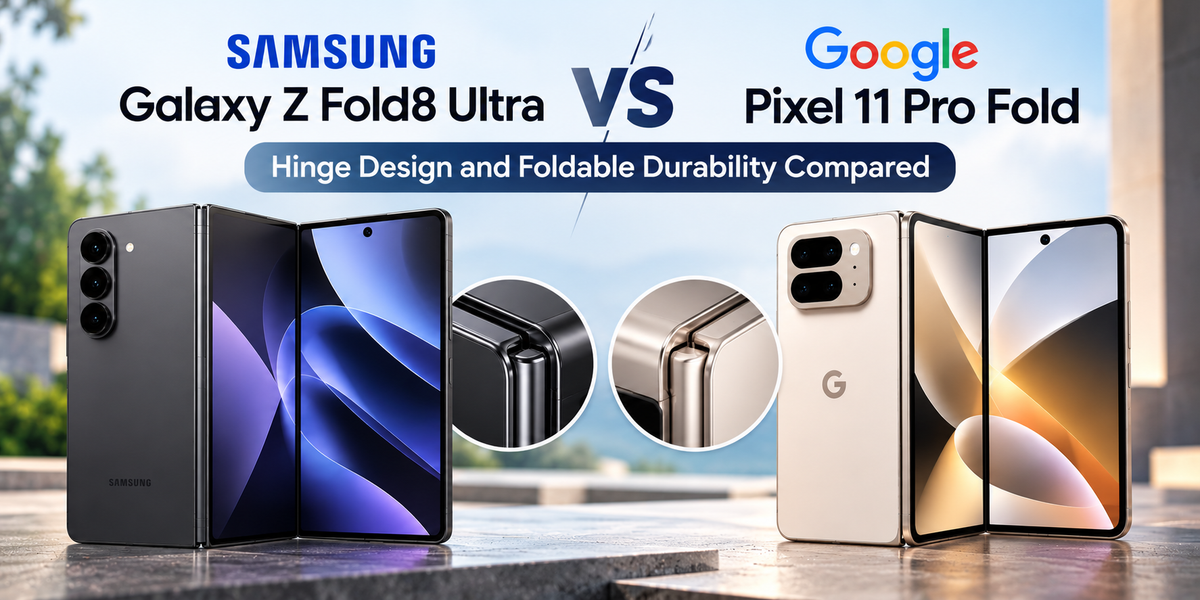








































Foldable smartphones have transformed how people use mobile devices, combining the convenience of a phone with the larger screen experience of a tablet. Two premium options attracting attention are the Google Pixel 11 Pro Fold and Samsung Galaxy Z Fold8 Ultra.Both target users who want more screen space for productivity, entertainment and multitasking. However, choosing between them involves more than comparing display sizes.Screen quality, hinge construction, software optimisation and everyday usability can significantly affect the foldable experience.In this guide, we'll explore the Google Pixel 11 Pro Fold vs Samsung Galaxy Z Fold8 Ultra, focusing on display technology, durability, multitasking and which device may better suit Australian buyers.
1. Foldable Display: Which Offers a Better Experience?
The display is the most important feature of a foldable smartphone.Both devices use a book-style design, allowing users to switch between a compact cover screen and a larger internal display.The Google Pixel 11 Pro Fold focuses on providing a familiar Android experience across both screens.Its larger display is useful for reading documents, browsing websites and watching videos.Samsung's Galaxy Z Fold series has traditionally prioritised large-screen productivity, offering a tablet-like experience when unfolded.For entertainment, both approaches provide more screen space than conventional smartphones.However, screen size alone does not determine display quality.Brightness, colour accuracy, refresh rate and software scaling also influence everyday usability.Verdict: Both designs offer significant advantages over conventional smartphones, but display preferences depend on the final specifications and software experience.
2. Display Quality and Outdoor Visibility
Premium foldable smartphones generally use OLED technology to deliver deep blacks, vibrant colours and strong contrast.High refresh rates can also improve scrolling, animations and supported gaming experiences.Outdoor visibility is especially important for Australian users who frequently use their phones in bright sunlight.A brighter display can make navigation, photography and messaging easier outdoors.However, advertised peak brightness does not always represent sustained brightness during normal use.Automatic brightness controls, thermal conditions and screen reflectivity can influence visibility.Before choosing either device, compare official brightness specifications and independent display testing.Verdict: The better outdoor display depends on real-world brightness, reflectivity and colour performance.
3. Screen Crease and Viewing Comfort
The foldable screen crease is another important consideration.Both devices use flexible displays that bend along a central hinge. As a result, a crease may be visible or noticeable when touching the screen.Samsung has refined the Galaxy Z Fold8 Ultra's internal display construction to reduce crease visibility.Google also uses ultra-thin glass and a redesigned hinge system in the Pixel 11 Pro Fold.In everyday use, the crease is often less noticeable when viewing bright content directly.However, visibility depends on lighting, viewing angles and individual preferences.Verdict: Samsung emphasises reduced crease visibility, but an in-person comparison is the best way to judge comfort.
4. Design, Thickness and Weight
Portability matters because foldable phones are carried both folded and unfolded.The Pixel 11 Pro Fold weighs 239g and measures 10.1mm thick when folded.The Galaxy Z Fold8 Ultra weighs approximately 215g and measures 8.9mm when folded.That makes Samsung's device around 24g lighter and 1.2mm thinner.These differences can be noticeable when holding the phone for extended periods or carrying it in a pocket.Both offer 6.5-inch cover displays and 8-inch internal displays.Verdict: Samsung has the advantage in weight and folded thickness. <Cite refs={["turn448524search7","turn448524search3"]}/>
5. Durability: Which Foldable Is Stronger?
Durability is particularly important because foldable smartphones contain moving components and flexible screens.The Pixel 11 Pro Fold features a strengthened hinge, glass-ceramic cover protection and an IP68 dust and water resistance rating.Samsung uses its Armor FlexHinge, Armor Aluminium frame, reinforced glass and protective titanium layers beneath the internal display.The Galaxy Z Fold8 Ultra carries an IP48 rating.An IP68 rating indicates a higher level of tested dust protection than IP48. However, neither rating guarantees protection against every environmental condition.Foldable screens also remain more vulnerable to concentrated pressure than conventional glass displays.Avoid placing sharp objects between the screens, and follow manufacturer instructions for cleaning and screen protection.Verdict: Google offers the stronger published dust-resistance rating, while Samsung emphasises its reinforced hinge and display construction. <Cite refs={["turn448524search0","turn448524search8","turn448524search9"]}/>
6. Multitasking: Google Pixel vs Samsung One UI
Multitasking is one of the biggest reasons to buy a foldable smartphone.The Pixel 11 Pro Fold supports split-screen applications, allowing users to work with two compatible apps simultaneously.For example, you can browse a website while taking notes or compare information between applications.Samsung's Galaxy Z Fold8 Ultra offers a more extensive multitasking environment through One UI.Its multi-window tools, taskbar and flexible window management are designed for productivity.Samsung also supports features that make switching between compatible applications more convenient.Verdict: Samsung is particularly attractive for users who regularly manage several applications, while Google's approach prioritises simplicity.
7. Productivity and Everyday Work
Both smartphones can help professionals complete tasks without carrying a separate tablet.The Pixel 11 Pro Fold integrates closely with Google services, including Gmail, Google Docs, Drive and Gemini.Its larger screen is useful for reviewing documents, attending video meetings and researching information.Samsung's Galaxy Z Fold8 Ultra offers extensive productivity features through its One UI ecosystem.Users can arrange supported applications across the larger display and switch between tasks efficiently.For students and casual professionals, either phone provides useful productivity benefits.However, people who frequently work across several applications may prefer Samsung's window-management options.
8. Software Experience and AI Features
Software optimisation plays a major role in foldable smartphone usability.The Pixel 11 Pro Fold runs Google's version of Android, with Gemini integration and Pixel-specific features.Google also promises seven years of operating system, security and Pixel Drop updates.Samsung combines Android with One UI and Galaxy AI features designed for productivity, communication and content creation.Both ecosystems provide intelligent tools, although availability may vary by region, language and software version.Verdict: Choose Google for its streamlined Pixel experience or Samsung for its extensive customisation and productivity features.
9. Which Foldable Is Better for Entertainment?
Both devices provide large 8-inch displays suitable for streaming, reading and gaming.The Pixel 11 Pro Fold offers a 120Hz OLED display with vibrant colours and smooth animations.Samsung's Galaxy Z Fold8 Ultra features an 8-inch Dynamic AMOLED 2X display with an adaptive 120Hz refresh rate.Samsung's internal display also has a higher stated pixel density.However, the difference may be difficult to notice during ordinary viewing.For movies, games and reading, both provide an immersive experience compared with standard smartphones.
10. Which Should Australian Buyers Choose?
Choose the Google Pixel 11 Pro Fold if you prefer Google's Android experience, Gemini integration, strong published dust protection and long-term software support.Choose the Samsung Galaxy Z Fold8 Ultra if you prioritise a thinner, lighter design, advanced multitasking and extensive productivity tools.Before purchasing, compare Australian prices, warranty coverage, storage configurations and local availability.Consider how frequently you'll use the larger internal display, as this determines whether a premium foldable offers meaningful value.