






































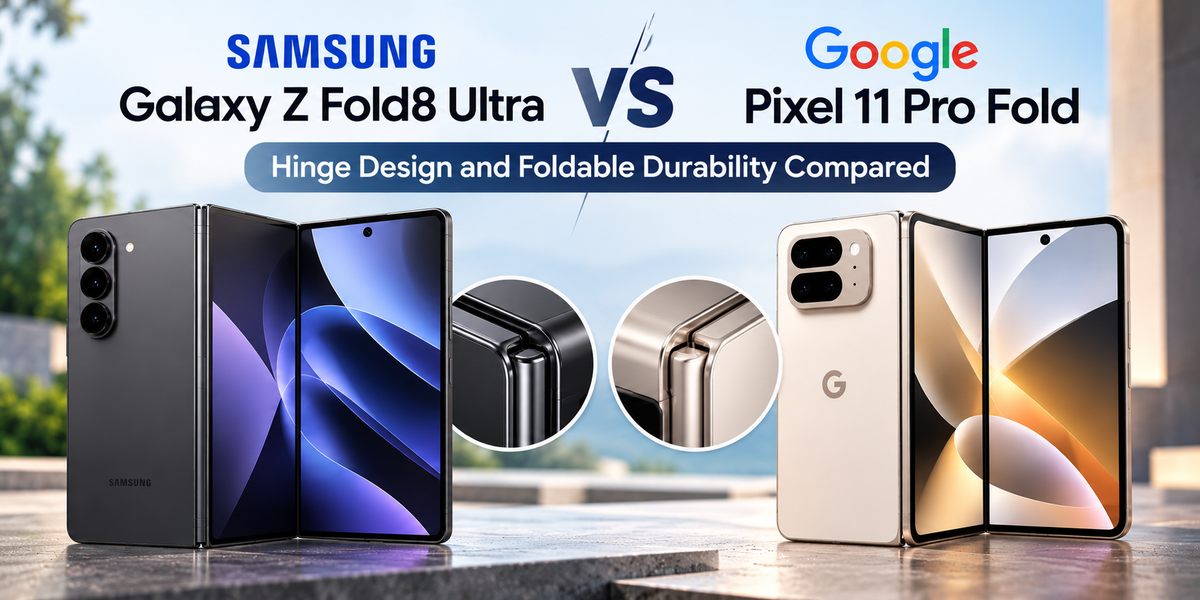
Foldable smartphones are becoming thinner, lighter and more durable with every generation. Two premium devices leading this evolution are the Samsung Galaxy Z Fold8 Ultra and Google Pixel 11 Pro Fold.Both smartphones feature advanced folding mechanisms, reinforced materials and large flexible displays. However, their hinge designs and approaches to durability are different.For buyers considering a premium foldable smartphone, understanding these differences is essential.In this comparison, we explore the Samsung Galaxy Z Fold8 Ultra vs Google Pixel 11 Pro Fold, focusing on hinge construction, screen protection, water resistance and long-term durability.
1. Hinge Design: How Do They Differ?
The hinge is one of the most important components of a foldable smartphone.It allows the flexible display to open and close while maintaining structural stability.
Samsung Galaxy Z Fold8 Ultra
Samsung uses its refined Armor FlexHinge, designed to provide smooth folding while reducing the overall thickness of the smartphone.The mechanism features a dual-rail design, helping support the device's slim construction.Samsung has also optimised hinge friction and magnetic tension to make opening and closing more comfortable.
Google Pixel 11 Pro Fold
Google introduces a redesigned gearless hinge that supports the flexible inner display.The hinge provides a larger bending radius, reducing stress on the folding screen.Google has also improved the internal display structure to enhance durability.Verdict: Samsung prioritises a slim, smooth-folding mechanism, while Google focuses on display protection and reduced folding stress.
2. Which Foldable Has a Stronger Hinge?
Hinge strength is essential because foldable smartphones may be opened and closed repeatedly throughout the day.Samsung's Armor FlexHinge combines a rigid structure with carefully engineered moving components. The company has conducted extensive reliability testing covering repeated folding, pressure and environThe company has conducted extensive reliability testing covering repeated folding, pressure and environmental conditions.Google's gearless hinge is designed to protect the internal display while improving the folding experience.However, comparing hinge strength directly requires independent testing under identical conditions.Neither manufacturer's design alone proves superior long-term mechanical reliability.Verdict: Both offer advanced hinge engineering, but there is insufficient comparable testing to declare an overall winner.
3. Foldable Display Crease: Which Is Less Noticeable?
The display crease is a common concern among foldable smartphone buyers.It forms where the flexible screen repeatedly bends.Samsung's Galaxy Z Fold8 Ultra incorporates Flex Titanium technology beneath the internal display.This reinforcement helps support the screen and reduce crease visibility.Google's Pixel 11 Pro Fold uses a larger hinge bending radius and thicker internal glass layer to improve crease performance.Both approaches aim to create a flatter viewing experience.However, the crease may remain visible under certain lighting conditions or viewing angles.Verdict: Both manufacturers have improved crease management, although real-world comparisons are necessary to determine which looks flatter.
4. Display Durability and Screen Protection
Foldable smartphones require different protective materials for their external and internal screens.Samsung uses Corning Gorilla Glass Ceramic 3 on the cover display and Gorilla Glass Victus 2 on the rear.Its internal screen includes Flex Titanium reinforcement, combining a titanium-alloy film with a supporting plate.Google uses ultra-durable ceramic cover glass and a reinforced internal folding display.The Pixel also features a glass-fibre composite back designed to improve resistance to cracking.Despite these improvements, both internal screens remain more sensitive to concentrated pressure than conventional smartphone displays.Users should avoid pressing sharp objects against the flexible screen.Verdict: Samsung offers extensive internal display reinforcement, while Google emphasises improved external protection and composite construction.
5. Water and Dust Resistance Compared
Water and dust resistance can significantly influence foldable smartphone durability.The Samsung Galaxy Z Fold8 Ultra carries an IP48 rating.This means it is tested against solid objects measuring 1mm or larger and against water immersion under specified laboratory conditions.The Google Pixel 11 Pro Fold features an IP68 rating.Its rating provides a higher level of tested protection against dust ingress, alongside water resistance.However, neither smartphone is completely waterproof or immune to environmental damage.Water resistance can also decrease through normal wear, accidental drops and repairs.Verdict: Google has the clear advantage in published dust-resistance ratings.
6. Thickness, Weight and Everyday Handling
A foldable smartphone should feel comfortable whether folded or unfolded.Samsung's Galaxy Z Fold8 Ultra weighs 215g and measures approximately 8.9mm thick when folded.Google's Pixel 11 Pro Fold weighs 239g and measures approximately 10.1mm thick when folded.Samsung is therefore around 24g lighter and 1.2mm thinner.This difference may be noticeable when carrying the phone in a pocket or using it one-handed.However, a thinner smartphone is not automatically more durable.Structural materials, hinge engineering and impact protection remain equally important.Verdict: Samsung wins for portability, while overall durability requires a broader comparison.
7. Which Foldable Is Better for Long-Term Use?
Long-term foldable durability depends on several factors beyond hinge construction.These include screen protection, resistance to debris, temperature exposure and everyday handling.Samsung's reinforced internal display and Armor FlexHinge are designed to withstand regular folding.Google's gearless hinge, composite back and IP68 rating also offer meaningful protection.However, both devices can still suffer damage from drops, impacts or improper handling.Independent long-term testing is necessary to establish how each device performs after years of use.Buyers should also consider repair availability, replacement screen costs and warranty conditions.
8. How to Protect Your Foldable Smartphone
Regardless of which smartphone you choose, proper care can help maintain its condition.
-
Use a compatible protective case: Choose one designed for the specific foldable model.
-
Keep the hinge clean: Avoid exposing the mechanism to sand, grit and debris.
-
Protect the inner screen: Do not apply excessive pressure or remove factory-installed protection without manufacturer guidance.
-
Avoid extreme temperatures: Excessive heat or cold may affect components and battery performance.
-
Handle the phone carefully: Avoid forcing the hinge or closing the screen around objects.
Following these precautions can reduce avoidable damage and help preserve the folding mechanism.
9. Which Foldable Should Australian Buyers Choose?
Choose the Samsung Galaxy Z Fold8 Ultra if you prioritise a lightweight design, slim construction and reinforced internal display.Its Armor FlexHinge and Flex Titanium technology make it an attractive option for users who frequently open their smartphone for productivity and entertainment.Choose the Google Pixel 11 Pro Fold if you value stronger published dust protection, a redesigned gearless hinge and a durable composite back.Australian buyers should also compare local warranty coverage, repair services and replacement costs before purchasing.