








































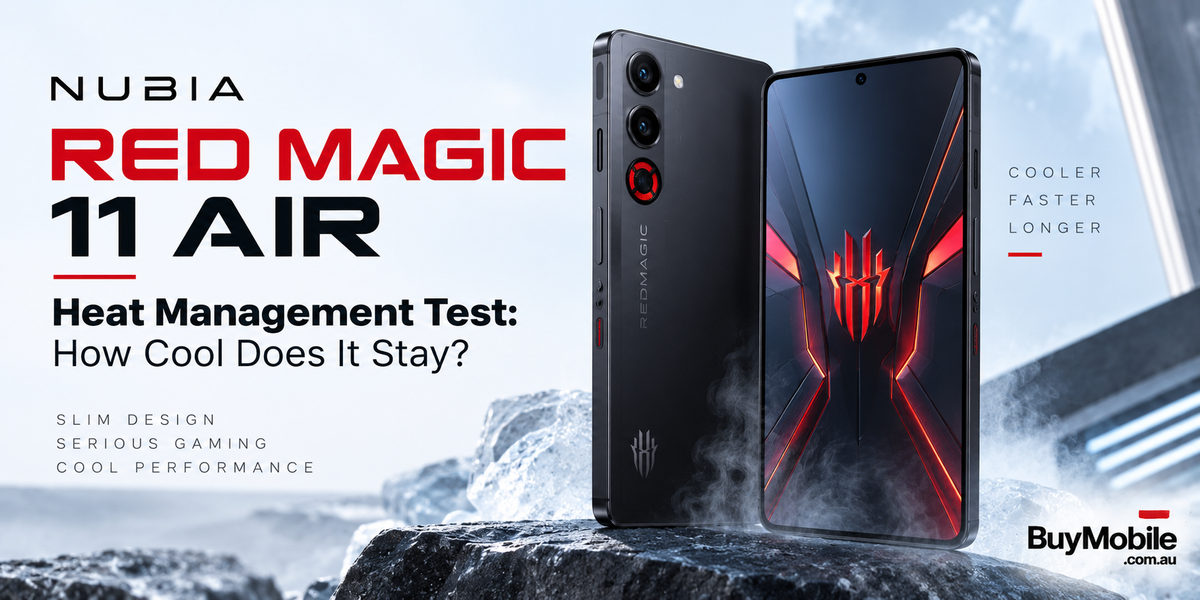
Gaming phones are expected to deliver high frame rates, but maintaining that performance for 30 minutes or an hour is much harder than producing an impressive benchmark score for a few minutes. Heat is usually the limiting factor. The Nubia Red Magic 11 Air tackles that problem aggressively, despite being only 7.85mm thick. It combines a Snapdragon 8 Elite processor with active fan cooling, a large vapour chamber and multiple heat-dissipation materials. So, how cool does it actually stay during demanding gaming?
Why Is Cooling So Important on the Red Magic 11 Air?
Modern mobile processors can generate considerable heat when the CPU and GPU are working continuously. If temperatures become too high, the phone can reduce processor speeds to control heat, potentially causing lower frame rates and inconsistent gameplay.The Red Magic 11 Air is particularly interesting because it packs flagship-class gaming hardware into a relatively slim body. Official specifications list a thickness of 7.85mm and weight of 207g. Inside is Qualcomm's Snapdragon 8 Elite alongside LPDDR5X Ultra memory and UFS 4.1 storage. Keeping that hardware cool inside a thin chassis is therefore a major part of the phone's design.
What Cooling System Does the Red Magic 11 Air Use?
Unlike most conventional smartphones, the Red Magic 11 Air doesn't rely entirely on passive heat dissipation.Its REDMAGIC ICE Cooling System combines an extra-thick vapour chamber, under-screen graphene copper foil, graphene composite material, thermal conductive gel and an aerospace-grade aluminium cooling bracket. Most importantly, there's an integrated turbo fan capable of spinning at up to 24,000 RPM.REDMAGIC says the larger tier-structured vapour chamber provides 40% better heat distribution and 40% more vapour space compared with its referenced previous design. Those are manufacturer claims, but the architecture shows how seriously the phone approaches sustained cooling. The idea is straightforward: spread heat quickly and then use active airflow to help move it away from critical components.
How Hot Does It Get Playing Genshin Impact?
Genshin Impact remains a useful test because maintaining high graphics settings for an extended period puts consistent pressure on both CPU and GPU.AnTuTu's testing ran Genshin Impact for 30 minutes at very high graphics settings with a 60fps target. The Red Magic 11 Air averaged 61fps with a 60.4fps 1% low. More importantly for this test, its hottest measured temperature was 40.5°C on the front and 41.3°C on the rear. Those results show something more meaningful than simply saying the phone gets "warm."The frame-rate curve remained remarkably consistent while the device was dissipating the heat generated by a demanding game. In other words, the cooling system isn't merely trying to make the phone comfortable to hold; it's helping the processor sustain its performance.
What Happens With an Even Heavier Game?
Honkai: Star Rail can place even greater sustained pressure on smartphone hardware.During AnTuTu's 30-minute test at maximum graphics settings, the Red Magic 11 Air averaged 60.9fps with a 53.4fps 1% low. Temperatures reached a maximum of 42.4°C on the front and 41.6°C on the rear. That's warmer than the Genshin test, as you'd expect from the heavier workload, but performance remained strong.Another independent test produced somewhat different temperatures, which is an important reminder that thermal results vary with ambient temperature, brightness, fan mode, game version and test methodology. PChome measured up to 43.4°C on the front and 45°C on the rear after a 15-minute high-load Star Rail session. During a longer stability run, local peak temperatures increased to 46.5°C and 47.2°C.So the phone can certainly become hot under prolonged maximum load. Active cooling doesn't mean cold gaming.
Does the 24,000 RPM Fan Actually Make a Difference?
Yes, although the difference depends on the workload and fan setting.One test compared Genshin Impact performance with the cooling fan disabled and then running at maximum speed. With the fan off, the phone averaged around 61fps after 30 minutes but reached a peak temperature of 46.4°C. With maximum fan cooling, performance remained similar while the peak temperature dropped to 44.9°C and stability improved slightly. That demonstrates the real purpose of active cooling.The fan isn't necessarily there to create dramatically higher frame rates every second. Its bigger advantage is helping manage accumulated heat during longer gaming sessions.If you're playing for ten minutes, you might not notice much difference. During an hour-long gaming session, better heat dissipation becomes increasingly valuable.
Does the Red Magic 11 Air Throttle?
Thermal throttling isn't inherently bad. It's a safety mechanism used by smartphones to prevent excessive temperatures. What gamers want to avoid is aggressive throttling that suddenly causes noticeable frame-rate drops.Real-game testing suggests the Red Magic 11 Air can maintain impressive consistency.AnTuTu recorded essentially flat performance during its 30-minute Genshin test, while its Star Rail results remained strong despite occasional fluctuations.However, synthetic stress testing can push the phone much further. Another test using 20 loops of 3DMark Wild Life reported 80.3% stability, with temperatures around the front, back and exhaust exceeding 65°C by the end. That's an extreme workload and shouldn't be treated as representative of normal gaming. It does demonstrate that the cooling system has physical limits.
Is the Phone Comfortable to Hold While Gaming?
Peak temperature doesn't tell the entire story.Where heat accumulates matters just as much. If the hottest point sits directly underneath your fingers, even moderate temperatures can become uncomfortable during a long session.PChome's thermal imaging found that heat was concentrated mainly around the chipset region, while the battery area remained considerably cooler during its Genshin testing. After 30 minutes, it measured approximately 40°C on the front and 39.8°C on the back. The active airflow design helps direct heat toward the cooling system rather than allowing it to accumulate evenly throughout the chassis.You'll still feel warmth when pushing the phone hard, but the thermal design is clearly intended with landscape gaming in mind.
Does the Slim Design Compromise Cooling?
This is arguably the most impressive part of the Red Magic 11 Air.At 7.85mm, the phone is relatively thin considering that it contains a 7,000mAh battery, active cooling hardware and flagship Snapdragon silicon.Usually, larger gaming phones have more physical room for heat spreaders, airflow channels and cooling hardware. REDMAGIC has had to package these components much more tightly here.There are compromises. Under extreme sustained stress, temperatures can still climb considerably. But normal demanding games provide a much more encouraging picture.
Should You Use the Fan All the Time?
Probably not.During messaging, browsing, streaming or other everyday tasks, the processor isn't continuously operating at maximum load, so active cooling isn't always necessary.Gaming is where the fan becomes useful.For demanding titles, particularly during long sessions, enabling stronger cooling can help control accumulated heat and maintain consistent performance.There's another benefit for players who game while charging. REDMAGIC provides Charge Separation, which can power the phone directly rather than continually charging the battery during gameplay. This can help reduce unnecessary battery heat and wear during plugged-in gaming sessions.
How Cool Does the Nubia Red Magic 11 Air Really Stay?
The Red Magic 11 Air doesn't magically remain cold. Under demanding games, testing shows temperatures commonly moving into roughly the low-40°C range, with heavier or longer workloads potentially pushing local hotspots considerably higher.What's more important is what happens to performance as the temperature rises.In 30-minute Genshin and Honkai: Star Rail testing, the Red Magic 11 Air maintained around 60fps while its active and passive cooling systems managed the heat. That's exactly what a gaming-focused thermal system is supposed to accomplish.The 24,000 RPM fan, vapour chamber, graphene layers and aluminium cooling structure aren't just specification-sheet extras. Together, they allow the Snapdragon 8 Elite to sustain demanding workloads more consistently.For long gaming sessions, the Red Magic 11 Air's biggest thermal achievement isn't staying completely cool. It's getting hot without quickly sacrificing the gaming performance you bought it for.